Tarik Wortham, Ella Kauffman
For thousands of years, humans have sought to understand the fundamental nature of matter. The concept of the atom has evolved dramatically from Dalton’s solid spheres to Thomson’s plum pudding, to Rutherford’s nuclear model, to Bohr’s planetary model, and finally to today’s quantum mechanical model with its probabilistic electron clouds. Each model represented scientific progress, yet each carried limitations that necessitated further refinement. For our project, we propose the Heisenberg Hotel Model, a creative yet abstract molecular model translating quantum concepts into relatable experiences, comprehensively simplifying the quantum world to make it accessible while maintaining scientific accuracy.
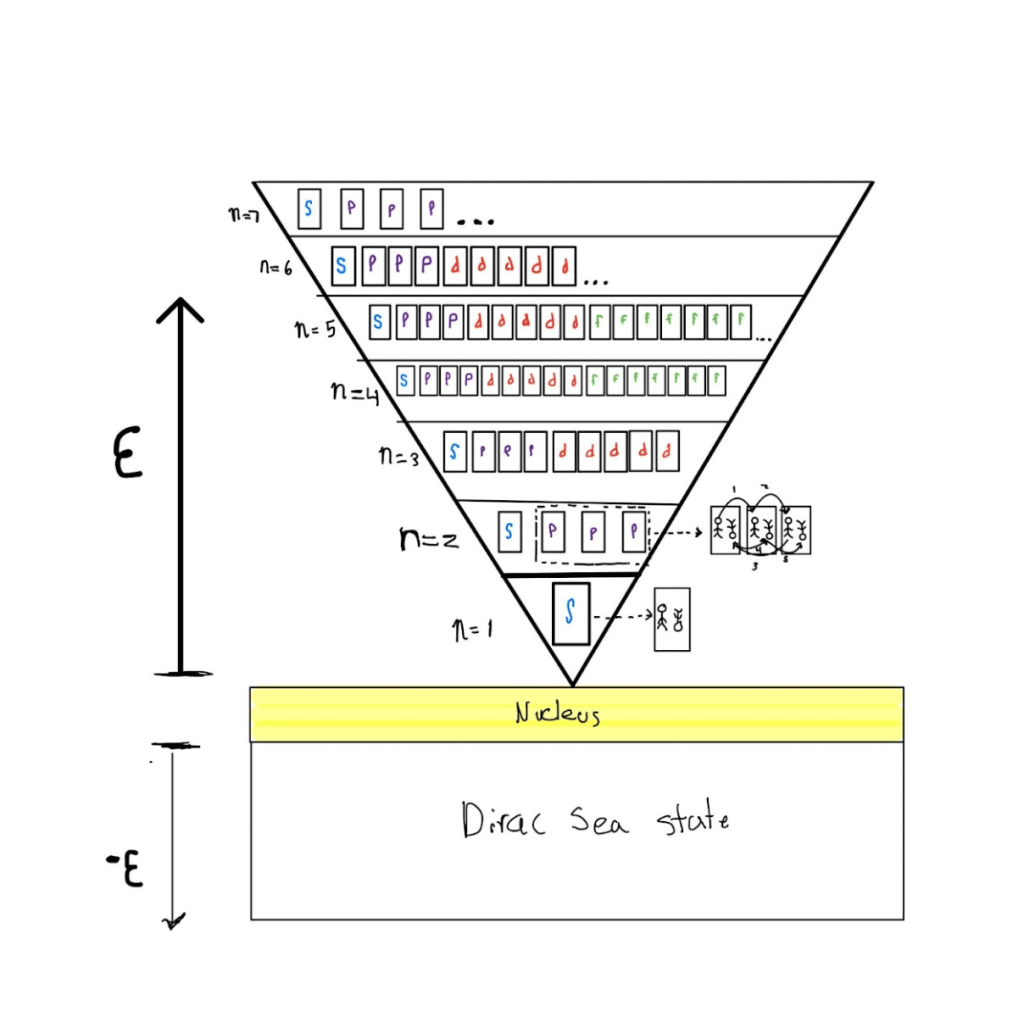
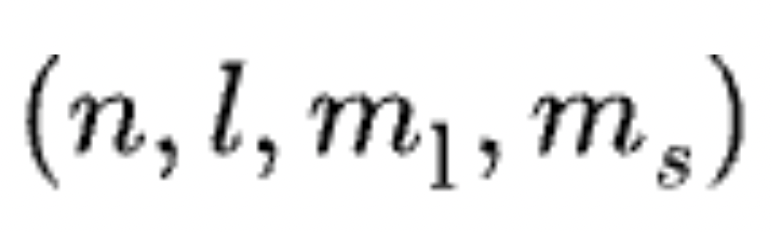
The Heisenberg Hotel is an innovative luxury hotel-hostel-like configuration that is ready to welcome guests (electrons). Each floor corresponds to a distinct energy level, n, each room a distinct orbital, l, and its corresponding orbital orientation, ml, and within those bedrooms, two beds that represent the magnetic spin, ms. The hotel is proposed to have infinitely many floors, like the Infinity Hotel1, as there is no theoretical maximum principal quantum number, which can also be referred to as energy level, n. However, at this time, there are 7 floors, each of which corresponds to a period (energy level) on the periodic table, since the highest principal quantum number on the Elements of the Periodic Table is 7.
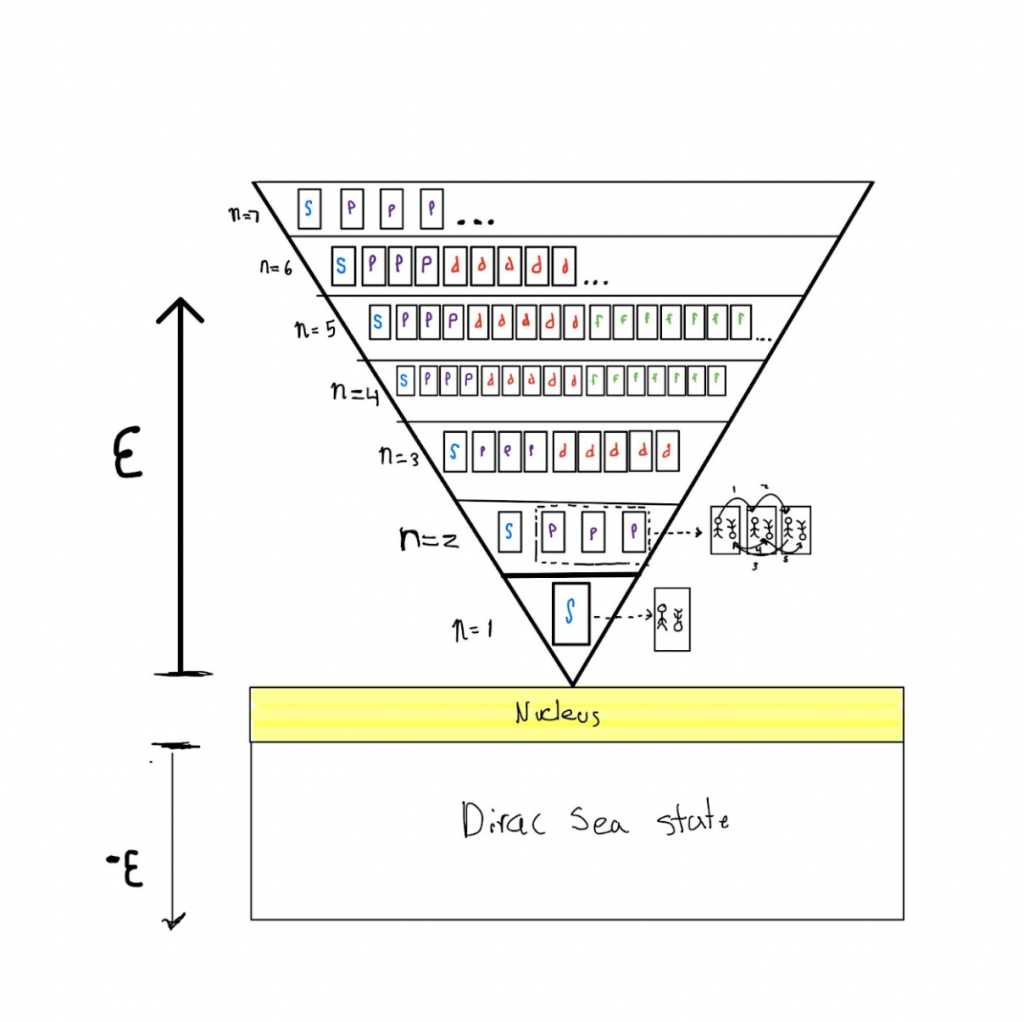
The hotel configuration comes into play where rooms fill up individually before they fill up doubly, and there are a maximum of two people in a room. People who are assigned to the s-orbital rooms have more privacy as they have one bedroom but the next person who checks in gets also assigned to the s room. The s-orbital room must fill before the p-orbital room. To make sure people fill in this order, the hotel organizes room assignments and rooms with “higher energy” have a higher price so, inevitably, guests are forced to fill within the pattern. In the p-orbital room 3 people at first have their rooms to themselves then the next three get placed in the same room, resembling the way orbitals fill through Hund’s rule of multiplicity. The process continues until all the rooms are filled reflecting the final element on the periodic table.
Additionally, hotels are mostly empty space, clearly embodying a prominent aspect of an atom. In the lobby of the hotel lives the nucleus of the atom, the lobby of a hotel is always central to everything, from the operations that run the hotel, like staff and security to restaurants, elevators, and other amenities, much like the nucleus of an atom. While a nucleus consists of protons and neutrons, the lobby consists of hotel staff (the neutrons) and stable security guards (the protons). The larger the hotel, the larger the lobby and the more people who work and maintain the environment, in the same regard a bigger atom, has a bigger nucleus.
Given the centrality of the lobby, guests who stay at the hotel represent the electrons. They exist around the lobby, occupying each floor level. For convenience, price, and organization purposes, the hotel people in rooms closest to the lobby in ascending order. The farther up guests go from the lobby represents each energy level that an atom has such as the quantum number, n. The people who stay closer to the ground level have less potential energy representing the stability of atoms in lower energy levels as opposed to higher energy levels
Our model does not account for either wave particle duality, or the Heisenberg uncertainty principle. When we use real people as electrons, it is not practical for people to behave like waves unlike electrons. To account for the Heisenberg uncertainty principle, there could be no cameras to monitor the guests within the hotel, but there is no possible way to see only where guests are or how fast guests are moving without the other.
However this model is very comprehensive as it can even go beyond this general understanding and deeper into the relatively unknown quantum universe, like the nature of positrons and the dirac-sea state2 that exemplify the negative energy shells electrons can occupy which is below the building in the basement. To explain further
The Heisenberg Hotel contracted Paul Dirac to solve a major issue with the hotel, the basement had a big leak, as the previous contractor, Schrodinger, deriving the energy of an electron using 1/2mv2 which breaks down with bigger atoms as electrons are spinning around the nucleus to speeds close to the speed of light, all the commotion at higher energy levels of hotel and water usage cannot be sustained by hotel thus resulting in a leak. Dirac derived energy from Einstein’s relativistic equations using E=mc2, and came up with an equation that accurately describes the energy of a singular atom and found that electrons can fill negative energy levels, reinforcing the basement and preventing further leaks.
Overall, The Heisenberg Hotel is a new and efficient way to show the atomic structure, relating the atom to a real world situation. Not only does it include multiple aspects of the real atomic structure, it also provides a comprehensive explanation and understanding of the atom.

 Quarks and Queries: Tales and Truths of Science
Leave a comment