- Abstract
Pressure-fed ethanol-liquid oxygen (LOX) engines offer a low-cost, reliable, small-scale application profile, but for such a hot-burning and low-energy density fuel, compared to hydrogen and methane propellant, their performance depends on nozzle design.
The nozzle design must address two things: high performance and high efficiency. This study investigates how highly efficient, compact nozzles can be designed through optimizing the expansion ratio and chamber pressure. Using Bernoulli’s principles, data from other engines, and rocket propulsion fundamentals, the research demonstrates it is mathematically feasible to design a compact engine that produces upwards of 15kN of thrust, runs for 300 seconds, and operates with a chamber pressure of 500PSI.
- Introduction
Pressure-fed engines date back to the early days of rocketry. Robert Goddard, the father of modern-day rocketry, used gasoline and liquid oxygen as a propellant. The problem he faced was how to stop the nozzle from burning. In World War II the Germans solved this problem with the Nazi V-2, which was a single stage rocket used to attack the Allied forces in World War 2. Its nozzle used regenerative cooling, but wasn’t the most efficient, only burning for 214-217 seconds (Tim Dodd). In hindsight, the V2’s poor guidance capabilities and combustion instability led to many unsuccessful launches, high expenditures, and missed bombing targets. While the rocket was riddled with shoddy engineering and faulty construction, it succeeded militarily, wreaking havoc on communities in the United Kingdom and Belgium, making the combined death toll of 9,000 civilians, not accounting for the Jewish people that died in concentration camps forced to produce German weapons (Imperial War Museums).
After World War II, the Allies brought in Nazi engineers to build ballistic missiles and launch their space programs. America, through Operation Paperclip, and the Soviet Union brought German scientists to their countries, where they used German principles of engineering and the Nazi V-2 engine design for Soviet and American rockets like the Mercury Redstone and the R-7 (Dodd, 2021). These rockets refined the combustion instability that the V2 rocket faced, but were not any more efficient (Redstone).
From the early 1960s and beyond, the development of pressure-fed Ethanol-LOX engines began to die as there were more efficient engines and fuels with higher energy density. In the 2000s, Rockedyne developed the RS-88, which was an open-cycle gas generator engine. And in 2014, some engineers in Brazil came together to develop the L75.
Today, Copenhagen Suborbitals and the MIT rocket team are developing pressure-fed bi-propellant engines, but their engines do not address the major facets of high-performance amateur rocketry: cheap production, high-performance, and high efficiency. The little development made to revitalize amateur rocketry inspires me to do this work. An engine of this sort on a rocket would be super useful for small businesses, schools, and other programs to secure a payload spot on a rocket without needing massive funding or resources.
- Defining Key Concepts
- The expansion ratio is the ratio of the exit area to the throat of the nozzle. This is extremely important in making an efficient engine, as a thinner throat area leads to less propellant being burned per unit time. When designing a rocket at sea level, as the expansion ratio gets higher, the rocket becomes more efficient, but overexpansion will lead to a decrease in thrust, and a decrease in thrust would lower performance.
- Chamber pressure also plays a key role in the efficiency of the engine. This is the pressure inside the combustion chamber the LOX and Ethanol burn in, and depending on the construction of your engine, the more pressure you start with, the faster the gas will go out of the nozzle.
- Thrust is the force that causes the rocket to move.
- Delta-v, or the change in velocity, describes how much a rocket can move with its engines.
- A Pressure Fed Cycle uses a pressurized inert gas like helium or nitrogen to feed or “push” propellant into the combustion chamber.
- Bernoulli’s principle states that as a fluid flows through its area of contraction or expansion it will always experience high pressure, low velocity at the throat and low pressure, high velocity at the exit.
- Design Process
- Constraints
The purpose of selecting an Ethanol-LOX propellant combination is that it meets the intersection of performance, safety, cost, and accessibility (Space Enterprise at Berkeley, 2022). Additionally, the pressure-fed concept reduces maintenance and construction time as there are fewer moving parts, and in turn guarantees a cheaper design. To build a cheap, small, reusable Ethanol-LOX engine, constraints can be set preemptively due to the nature of the engine.
To satisfy these constraints, a pressure-fed system’s theoretical maximum chamber pressure is 500 PSI. If this number is exceeded, it will be hard to get high enough pressure into the injector (Space Enterprise at Berkeley, 2022). Additionally, to maintain the small scale of the nozzle, the exit diameter is limited to 20 inches. Finally, a high-performance engine that carries payload must have more than 100kN of thrust (Copenhagen Suborbitals, n.d.).
- First Iteration: UC Berkeley Rocket (Space Enterprise at Berkeley, 2022)
The Berkeley Space Enterprise has a goal of sending a rocket to space. This video shows their take on designing and engineering a nozzle that achieves that goal. The design considerations they made were to design a conical nozzle as it is easier and cheaper to machine, they use isoentropic flow equations to find the optimal parameters and size of the nozzle. The engine achieves 15 kN of thrust and has a specific impulse of around 300 seconds, making a fair mix of efficiency and performance. However, the geometry of a conical nozzle limits its expansion ratio and, at high pressures, causes it to face combustion complications, so the performance parameter of their engine would only work if their engine is bell-shaped. Additionally, the nozzle is fairly big, exceeding a meter in length which doesn’t fall within the limitations of making a compact nozzle.
- Charlie Garcia (Garcia, n.d.)
Charlie Garcia’s construction of a liquid rocket engine provides a comprehensive guide to designing an engine nozzle. Garcia uses the Rocket Propulsion Analysis (image below) software and sets many parameters for the software to create an engine contour.
The engine he designs has an expansion ratio of 13, achieves 5 – 6 kN of thrust, has a mass flow rate of 2.2 kg/s, and an ISP of 288 seconds. A simple cost-benefit analysis would indicate that while it is a highly efficient engine, it would be advantageous to produce more thrust. The overexpansion of the nozzle contributes to a loss of thrust, as overexpansion means that the exit pressure of the gas is less than the ambient air temperature. If the exit pressure drops far below the ambient atmospheric pressure, the engine may be prone to flow separation, significantly impacting performance. In the final design of the engine, this performance hindrance must be addressed.
- Analyzing the L75 engine data (da Silva Mota et al., 2018)
This data is taken from the L75 open-cycle gas generator engine, an industrial-sized engine optimized for vacuum performance. To derive meaningful information from this data to make a small-scale pressure-fed engine, there is very little that can be analyzed, so more importantly, there are trends that can be observed in the data, such as how manipulating chamber pressure changes the efficiency of the engine.
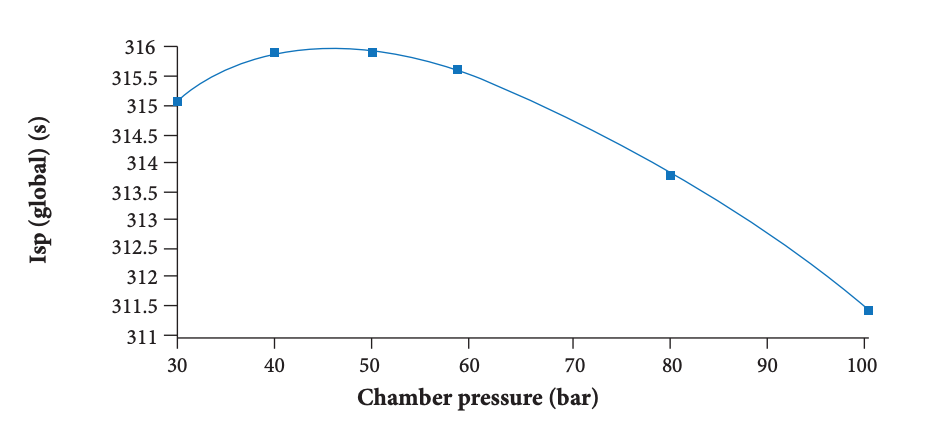
The data shown above shows that the peak efficiency for an open-cycle gas generator engine is within the 30-50 bar range (480psi-680psi). As stated in section 3.1, this number for a pressure-fed cycle peaks at the 30 -35 bar range instead of the 45 bar range that this engine peaks at.
- Conclusion
This study finds that expansion ratio optimization along with other values can influence the performance and efficiency of any engine, and can greatly do so for lower energy density propellants. Revitalizing the work done in the 1960’s space age, has highlighted a pathway towards affordable space exploration and experimentation, and towards having efficiency and performance level once unattainable for small engines. The current space age is obsessed with advancing propulsion, but maybe to advance our understanding of the world and develop new technologies, we need to use is right in front of us.
References
Copenhagen Suborbitals. (n.d.). Spica. https://copenhagensuborbitals.com/missions/spica/
da Silva Mota, F. A., Hinckel, J. N., Rocco, E. M., & Schlingloff, H. (2018). Modeling and Analysis of a LOX/Ethanol Liquid Rocket Engine. SciELO. Retrieved May 23, 2025, from https://www.scielo.br/j/jatm/a/4mwKyLd8TvCCKkxSJPqMX8C/?lang=en
Dodd, T. (2021, November 24). The Entire Soviet Rocket Engine Family Tree. YouTube. Retrieved May 23, 2025, from https://www.youtube.com/watch?v=Y-xyXDiC92s
Garcia, C. (n.d.).
Imperial War Museums. (2023, September 20). The V2 rocket was pointless, and here’s why. YouTube. Retrieved May 18, 2025, from https://www.youtube.com/watch?v=SC-j7le8i_0
MIT. (2022, July 7). Topic 6: Injector Design – MIT Rocket Team. MIT Wiki Service. Retrieved May 9, 2025, from https://wikis.mit.edu/confluence/display/RocketTeam/Topic+6%3A+Injector+Design
Space Enterprise at Berkeley. (2022, October 10). Rocket Engine Fundamentals and Design Part 2/2: Nozzle Expansion and Design Example. YouTube. Retrieved May 20, 2025, from https://www.youtube.com/watch?v=yMrJl-lJrRI



Leave a Reply